

Why Quantum Sensing Belongs in the ASCEND Technologies Conversation
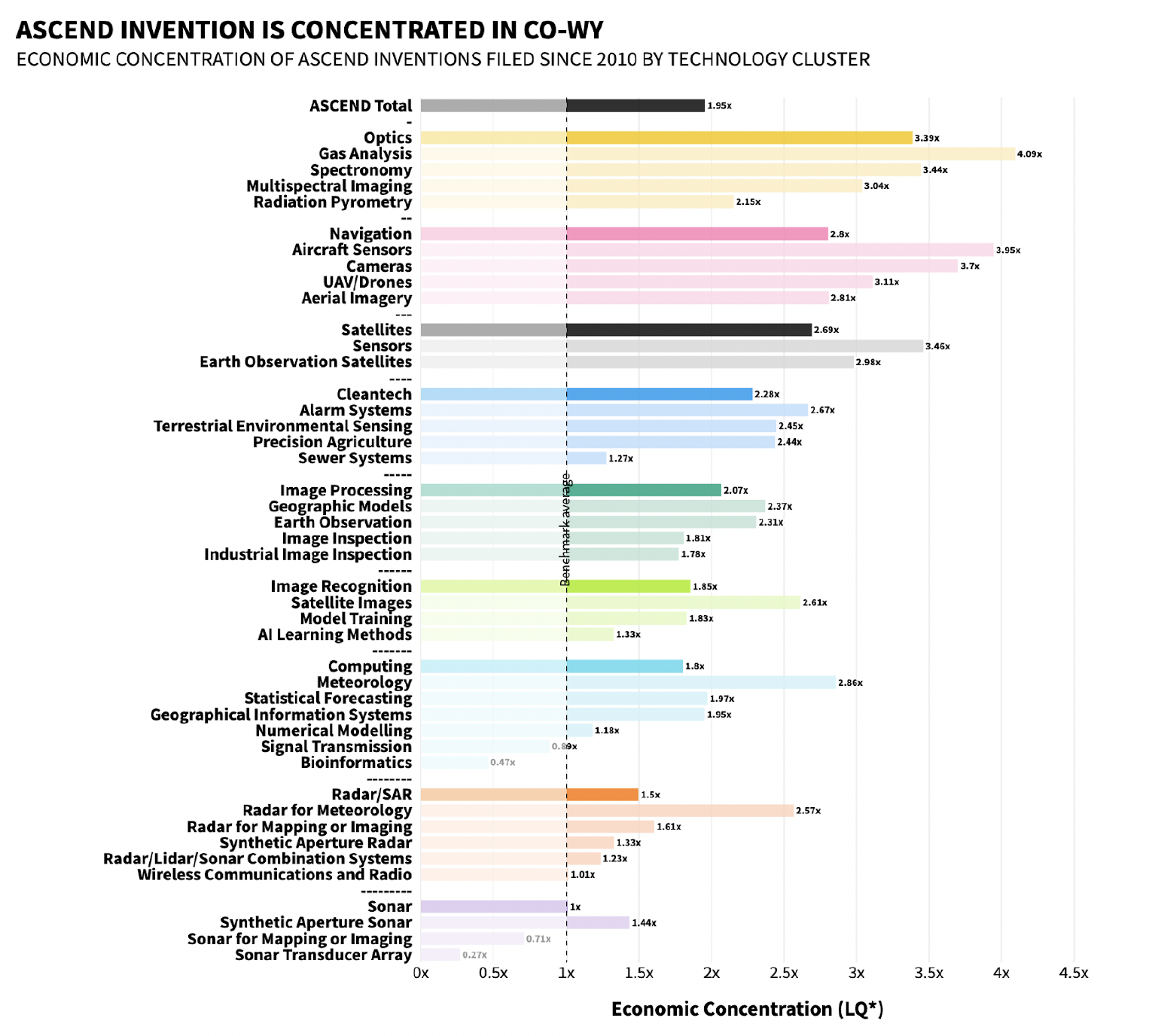
The goal of regional innovation engines and technology hubs (such as the NSF ASCEND Engine and Elevate Quantum) is to identify their region’s local and technical strengths and then leverage these strengths toward federal missions, advancing key technologies, and addressing pressing societal, national, and geostrategic challenges.
A recent report commissioned by Innosphere offers the most rigorous look to date at the intersection of quantum sensing and ASCEND-relevant applications, relying on the identification of where intellectual property is being generated globally and in the U.S. Its conclusion is that this isn’t a finished market, but the opportunities it represents are very real. With the support of the NSF ASCEND Engine, the Mountain West is well-positioned to become a strategic player by increasing regional capacity and developing networks focused on techno-economic advancement.
What Quantum Sensing Can do to Further ASCEND Technologies
While classical sensors have gotten us far, they have limits in sensitivity, the environments where they can reliably operate, and the precision they can sustain. Quantum sensors are the next step forward and can achieve measurement capabilities that traditional systems can't match by exploiting quantum mechanical effects (superposition, entanglement, interference).
“Quantum sensing matters because it promises sharper ways to measure time, motion, gravity, magnetic fields, and other physical signals that conventional systems often capture with lower precision or robustness. That makes it relevant to a wide range of applications where performance depends on trusted measurement: navigation when GPS is degraded, timing and synchronization for critical systems, geophysical and subsurface detection, industrial measurement, infrastructure monitoring, and a variety of aerospace and security uses.”
For ASCEND's core focus areas (advanced sensing, advanced computation, and supported decision-making), those capabilities matter. More precise sensing can improve drought monitoring and wildfire detection. Quantum-enhanced timing and navigation supports resilient positioning systems when infrastructure is under stress. Better atmospheric measurement tools can feed the models that underpin more accurate hazard warnings. Quantum sensing belongs in ASCEND conversations for these reasons, "not as a finished market category, but as an emerging layer of advanced sensing capability with credible long-term relevance to environmental and infrastructure decision systems."
Quantum has the potential to significantly enhance ASCEND technology capabilities, and the NSF ASCEND Engine and Elevate Quantum, Colorado’s EDA-funded Tech Hub, have established a relationship to ensure that potential isn’t wasted.
The Colorado Innovation Council (CIC) is Innosphere's cross-sector coordination initiative, bringing together Colorado's four nationally significant advanced industry programs — including Elevate Quantum, the Colorado BioScience Association, the Colorado Space Coalition, and the NSF ASCEND Engine — under a unified strategic umbrella.
The hope is that through this council, these four advanced industries can facilitate coordination, avoid siloing technology, and connect startups, capital, research institutions, and federal infrastructure to accelerate Colorado's position as a leading innovation economy.
ASCEND Innovation is Accelerating
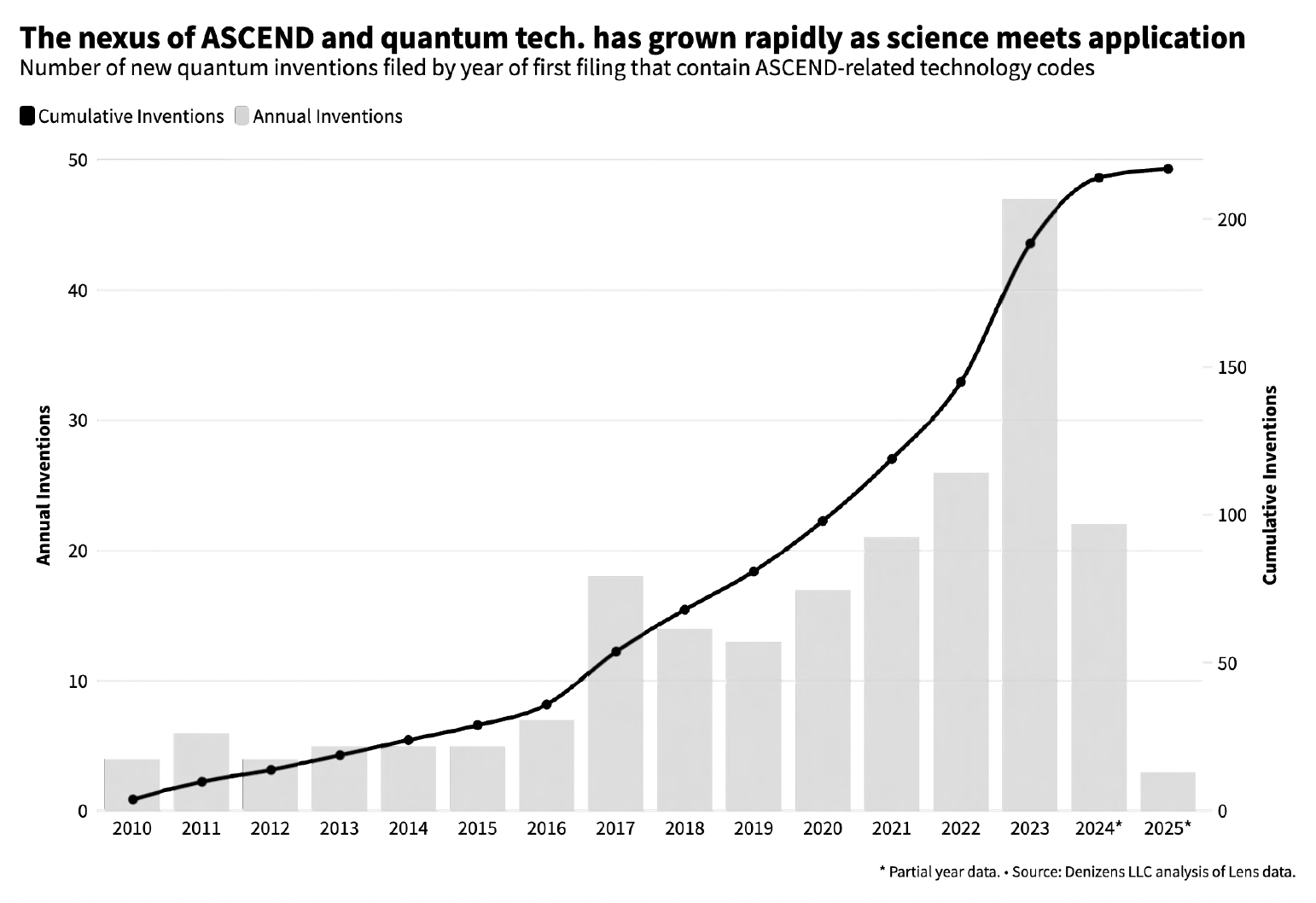
The number of new inventions with ASCEND-related technology codes grew steadily through the 2010s, then accelerated sharply. Annual ASCEND-adjacent quantum inventions reached their highest levels in 2022 and 2023, and cumulative totals now stand above 200. Roughly three-quarters of that growth has happened since 2020. This means that the specific technologies needed for quantum to be validated and to scale are growing, and they are growing fast enough and alongside the institutions and infrastructure necessary to make quantum technology into something deployable in the real world.
The ASCEND Tech Stacks Strategic Role
The report's most important insight about ASCEND technologies is on what must happen before quantum-enabled products are ready to deploy.
Quantum sensing becomes useful only when it can be validated, calibrated, and integrated into existing decision-making workflows. A sensor that performs brilliantly in a lab is not yet a tool that emergency managers, meteorologists, land managers, or infrastructure operators can rely on. Getting from one to the other requires calibration regimes, field-validation environments, interoperability standards, and buyers willing to run pilots under real operational conditions.
Here's where the NSF ASCEND Engine plays a pivotal role.
According to the report, “For the NSF ASCEND Engine...the most strategic interventions are not likely to begin with a long list of ASCEND-related quantum-enabled end products ready to be developed. They are more likely to begin with the technical and institutional layers that make trusted quantum sensing in ASCEND applications possible in the first place.”
That's what the report calls a "measurement-and-trust agenda" — and it's precisely the kind of agenda that an innovation engine is positioned to advance. The Mountain West already holds the measurement depth and the mission-oriented engineering capacity to anchor that work. NIST and JILA in Boulder provide metrology and calibration infrastructure that few regions can match. Sandia and Los Alamos in New Mexico bring hardening, qualification, and mission-deployment experience. And the NSF ASCEND Engine is working hard to establish the institutional layers needed to advance quantum through close partnerships with federal research labs, industry partners, top-tier research universities, and ASCEND-focused research programs. For technological validation, the NSF ASCEND Engine is also establishing a network of decentralized test beds where ASCEND technologies, and potentially future quantum technologies, can be validated and field-tested.
The NSF ASCEND Engine's most strategic contribution to quantum sensing isn't waiting for a product that's ready off the shelf. It's helping build the validation pathways, shared test environments, and integration capacity that make trusted quantum sensing in ASCEND applications possible - before the broader market arrives.
Read the executive summary.
Read the full report.