

The Front Range Loses Ground: Understanding the Trends in Milken's Best-Performing Cities Report
On September 17, Innosphere will host a special session of Innovation After Hours featuring the authors of the Milken Institute’s Best-Performing Cities report. This event will bring together hundreds of entrepreneurs, economic and innovation leaders from across Colorado’s innovation ecosystem for an evening of data, dialogue and networking.
"Every year, our Best-Performing Cities report shows the same thing: momentum isn't distributed evenly, even within a single state," says Brock Smith, PhD, a Director on the Milken Research team. "Colorado Springs cracked our top five nationally this year [2025], while Denver actually slipped in the rankings. That gap tells you something — the talent and infrastructure are there, but not every metro is converting them into the same competitive edge. That's exactly what we'll unpack, and why it matters for how Colorado positions itself against places like Austin and the Research Triangle."
This event is open to the public and a rare opportunity to be a part of Colorado’s economic future. To register, go to: Innovation After Hours Featuring Milken
What is Milken’s Best-Performing Cities Report?
The Milken Institute's Best-Performing Cities index scores the nation's large metros, 206 in the 2026 edition, on 13 indicators organized into three weighted categories:
- Labor market conditions (50 percent of the score: job growth 30, wage growth 20)
- High-tech impact (25 percent)
- Access to economic opportunities (25 percent: housing affordability, broadband access, community resilience, and income distribution, at 6.25 percent each).
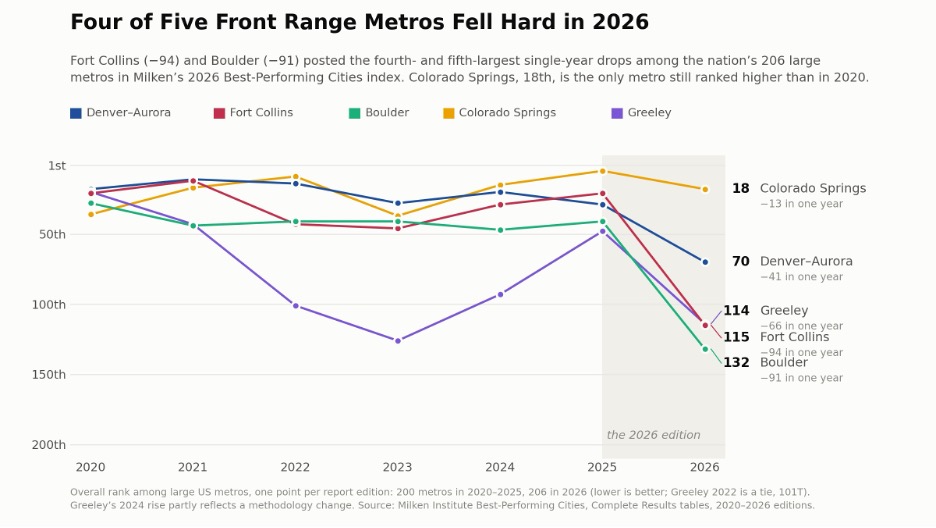
Across the 2020 through 2026 editions, the five Front Range metros went from averaging 25th in the country to 90th. In 2020, all five ranked in the national top 50; today only one does.
2026 Colorado Best Cities Rankings
The Drivers of Decline
Most of the decline happened between the 2025 and 2026 rankings. Fort Collins fell 94 places and Boulder 91, the fourth- and fifth-largest single-year drops of any large metro in the country; Greeley fell 66 spots and Denver 41. Colorado Springs also slipped, from 5th to 18th, but it is the only Front Range metro ranked higher today than in 2020.
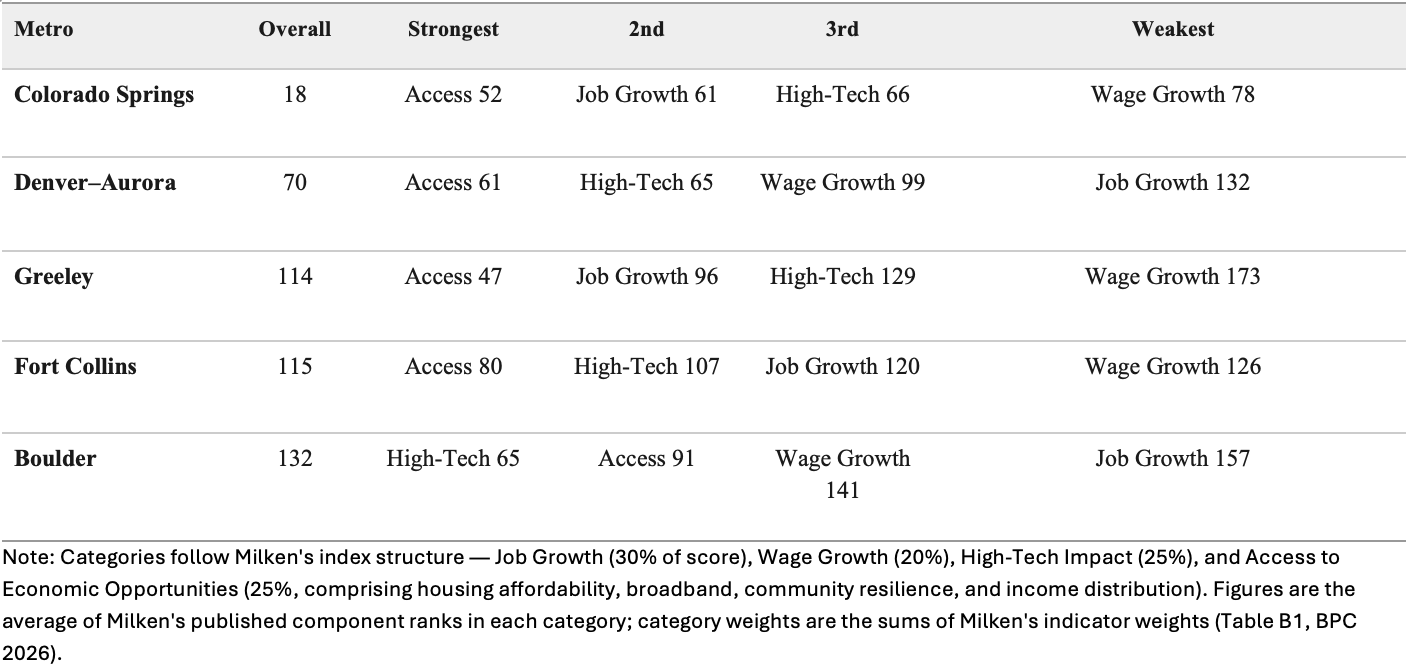
The two biggest falls, Boulder and Fort Collins have different causes. Boulder's decline was largely due to reduced job growth, its ranking dropping in that category fell from 62nd to 157th after professional and business services, its largest employment sector, shrank in 2024. For Fort Collins, the driving factor was wages, falling from 31st to 126th. Denver suffered no significant dip in any single year before 2026, but its job-growth ranking has declined steadily since 2023.
Rank and Housing Affordability
In the 2026 report, Milken identifies a clear positive relationship between a metro's sustained job growth and its housing affordability. With the exception of Greeley at 77th in the 2024 edition, no Front Range metro has ranked in the top half nationally on affordability in any edition since 2022.
How to Improve Colorado’s Standing
The Colorado Front Range is weakest in the two areas most challenging to improve: job and wage growth. However, as a venture development organization (VDO), these are the areas where Innosphere has the most potential for impact. VDOs such as Innosphere bring acceleration, capital, infrastructure, and partners together to improve a region’s economic prosperity and national competitiveness. In Innosphere’s case, this manifests as sector-specific accelerators, facilitated access to capital, leading the NSF ASCEND Regional Innovation Engine, and convening the Colorado Innovation Council.
Specifically, Innosphere advances regional competitiveness by:
- Creating and expanding pathways from innovation to commercialization and company formation by creating specialized accelerators, test-beds, supported pilot programs, tech-to-CEO matching, and convening industry and cross-industry gatherings.
- Connecting entrepreneurs with capital through networking, Meet the Investor events, Competitiveness Conversations, etc.
- Supporting the attraction, retention, and expansion of high-growth industries and businesses through a business recruitment partnership with the Metro Denver Economic Development Corporation
- Convening regional stakeholders around shared economic priorities and actionable strategies for long-term growth.
The most recent development in regional integration is the establishment of the Colorado Innovation Council (CIC). Established and coordinated by Innosphere, the CIC is a cross-sector initiative bringing together Colorado's four nationally significant advanced industry programs — namely Elevate Quantum, the Colorado BioScience Association, the Colorado Space Coalition, and the NSF ASCEND Engine — under a unified strategic umbrella. Its purpose is to close the coordination gap between industry-specific organizations that too often operate in parallel silos, connecting startups, capital, research institutions, and federal infrastructure.
Combined, these resources help the Front Range capitalize on its innovative potential; the region is already home to one of the nation’s highest concentrations of federal laboratories, several R1 research universities, and a highly skilled workforce.