

The Business of Business in Colorado

Colorado’s rise as a nationally competitive innovation economy rests not only on its research excellence and workforce strength but also on the overall business environment that supports startup creation, capital formation, and long-term company growth. Pages twelve through nineteen of our recently released Regional Competitiveness Report provide a detailed look at how Colorado performs across three essential pillars of economic competitiveness: the business climate, state support systems, and venture capital activity. The data paints a picture of a state with strong entrepreneurial momentum and well-developed public sector tools. Despite this, Colorado still faces key opportunities to expand its influence and economic impact.
A Supportive Business Climate and State Structure
Colorado’s business climate stands out for its entrepreneurial dynamism and population growth. The state ranks seventh nationally in core startup rate, placing it well above the comparison regions in Minnesota, North Carolina, and Georgia. Colorado also maintains one of the highest shares of workers at young firms, at nearly 12%. This is a crucial indicator of how effectively a region generates new business activity and attracts talent. Young firms are some of the greatest contributors to job creation, innovation, and economic diversification.
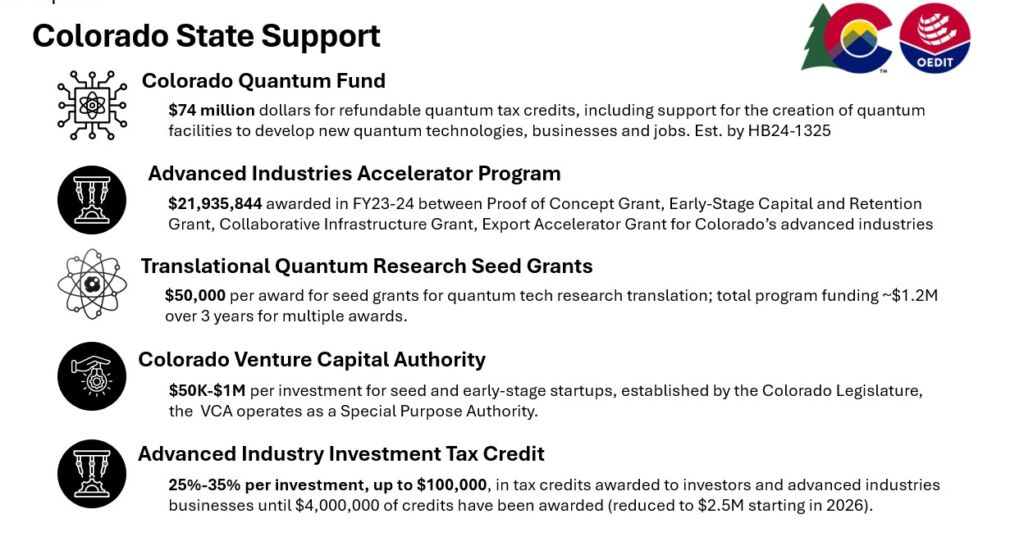
While the business climate sets the stage, Colorado’s state support structure helps fuel the growth of advanced industries and foster stable conditions for scaling. As shown on page fourteen, Colorado offers a comprehensive suite of programs, including the Advanced Industries Accelerator Program, the Colorado Venture Capital Authority, the Quantum Research Seed Grants, and the Colorado Quantum Fund, which provides seventy-four million dollars in refundable tax credits for the expansion of quantum research and commercial activity. These programs make Colorado one of the most proactive states in targeting advanced industries and supporting early-stage companies with both capital and research-driven grantmaking. Comparing Colorado to peer regions reveals unique differences in strategy. Georgia’s Invest Georgia Fund, Minnesota’s Forward Fund, and North Carolina’s Biotechnology Center each provide important support, but none match Colorado’s combined focus on quantum technology, advanced manufacturing, and diversified early-stage financing.
The availability of venture capital is another crucial dimension of regional competitiveness with Colorado standing as the clear leader across the comparison group. Colorado generated more than two thousand VC-backed startups between 2020 and 2024, nearly double Georgia and far exceeding both North Carolina and Minnesota. During the same period, total venture investment exceeded $27 billion, placing Colorado far ahead of its peers with North Carolina at $18.6 billion, Georgia at $12.1 billion, and Minnesota at $10.3 billion. Colorado also leads in per capita innovation funding, attracting $1009 in per-capita innovation funding in 2023, almost double North Carolina, the next-closest competitor. This reflects both strong venture capital inflows and significant SBIR and STTR funding, highlighting Colorado’s appeal to both private and federal funders.
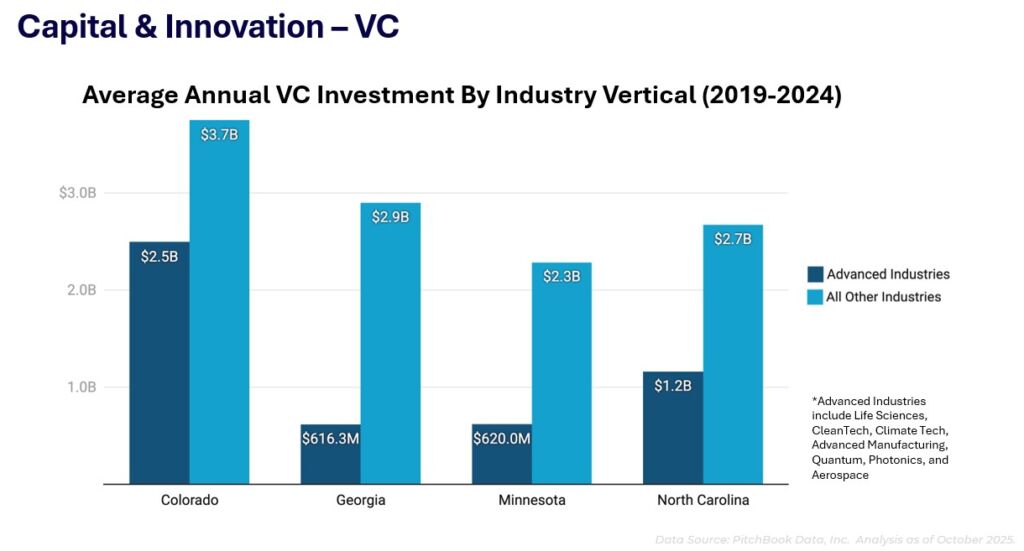
Despite these advantages, Colorado faces a notable challenge in its venture economy, as the majority of Colorado’s VC dollars come from out-of-state investors. While this demonstrates strong nationwide confidence in Colorado’s innovation ecosystem, it also means that financial returns often leave the state following startup exits. This limits the long-term compounding effect of venture activity. Expanding in-state venture funds and mobilizing institutional investors present major opportunities to strengthen Colorado’s economic capture of the wealth it generates.
Colorado’s high patent production, federal lab concentration, R1 university output, and spinout creation all contribute to the state’s appeal for investors and entrepreneurs. Colorado produces more patents per capita than Atlanta and the Research Triangle, and only narrowly trails the Twin Cities. It also hosts more federal labs than any of the comparison regions, which supports greater R&D activity and attracts companies building deep-tech solutions. Further, these patents, institutions, and research outputs are heavily concentrated around advanced industries including quantum technology, aerospace, and biosciences.
Overall, Colorado’s business climate enables consistent startup formation. Its state support programs create institutional stability for advanced industries. Its venture capital environment injects powerful financial momentum into high-growth companies. Together, these factors generate an ecosystem with significant competitive advantages and strong long-term potential. As actors across the state continue to invest in innovation, the Front Range is positioned to solidify its role as one of the country’s leading centers for advanced industry development.