

Regional Innovation Hubs—and Why Colorado–Wyoming Matters
.jpeg)
The United States has long concentrated its innovation economy along the coasts — San Francisco/Silicon Valley, Los Angeles, Seattle, Boston, New York, Washington, D.C. But a second generation of technology regions is emerging across America's interior, and Colorado’s Front Range is leading that shift.
Colorado and Wyoming’s Front Range were recently identified in a Denizen’s report as having specific areas of innovative and technological advantage relative to other leading regions in the nation. Collectively known as ASCEND Technologies (Advanced Sensing and Computation for Environmental Decision Making), these technologies “comprise a growing constellation of tools that capture, analyze, and interpret environmental conditions to enable real-time decision making.” These tools include a rapidly expanding class of systems that combine environmental sensing, artificial intelligence, advanced computation, and real‑time analytics to transform raw environmental data into actionable insight.
Recent global patent analysis makes clear that ASCEND technologies are no longer niche, but are becoming a strategic and important technology domain. The Colorado-Wyoming (CO-WY) region ranks in the top 10 regions for ASCEND invention volume and fourth in ASCEND patents per job.
What Are ASCEND Technologies?
ASCEND technologies are not a single industry or product category. Rather, they are a technology stack representing a tightly integrated system of sensors, analytics, and AI models that translate raw environmental data into actionable and trustworthy insight, often through the use of digital-twins. And, this is one of the Colorado Front Range’s key innovation and technological advantages.
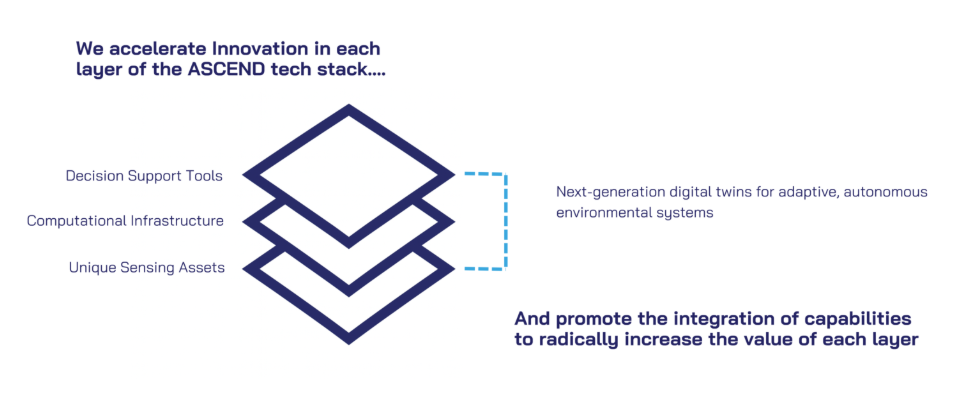
The foundation of ASCEND technologies are advanced sensing platforms: satellites, radar, lidar, optical instruments, and in‑situ environmental monitors. These technologies form the perception layer, capturing continuous streams of environmental data across land, air, sea, and space.
Advanced computation capabilities then process the gathered environmental data using AI‑driven image recognition, numerical modeling, simulation, digital twins, and predictive analytics. These systems interpret data, detect patterns, and forecast future states—often autonomously and in near‑real time.
The final part of the tech stack consists of taking the processed information and turning it into operational action, whether that means reallocating water resources, issuing wildfire alerts, optimizing crop yields, or informing military and intelligence planning.
The strategic value of ASCEND lies not in any single layer, but in their convergence. A radar sensor without AI is limited. AI without real‑world sensing is blind. Together, they enable systems that can perceive, understand, and offer actionable insights in dynamic environments that will lead to better informed and more resilient communities.
The NSF ASCEND Engine and Regional Innovation
The National Science Foundation-funded ASCEND Engine in Colorado and Wyoming, established in 2024, is focused on accelerating the development and deployment of ASCEND Technologies. Over the next three years, the NSF will provide up to $45M in additional funding to execute a series of high impact programs including:
- Accelerators focused upon the ASCEND Engine’s two flagship R&D programs: ARID and SHIELD. ARID stands for Asset Resilience through Intelligent Digital Twins, and focuses on wildfire modeling as it pertains to power and water utilities. SHIELD stands for Soil Health Innovation, Evaluation, and Demonstration, and will focus on soil health using field-level soil test sites across CO-WY.
- A supportive startup pipeline. The NSF ASCEND Engine has already distributed 5 million in grants and will host another call for proposals later in 2026. Startups also have access to the Engine's extensive network, and the Engine will soon be operating a CEO-to-startup matching service.
- Clear pathways to commercialization, including access to accelerators catering to ASCEND technologies. For example, the engine recently concluded a Digital Twins Accelerator and is currently running an Earth & Space Systems Accelerator.
- Workforce development initiatives that support K-12 STEM education, stackable certifications for non-degreed workers, undergraduate internships, and fellowships all of which support the creation of a workforce ready to support ASCEND technology development and deployment.
Learn more about ASCEND Technologies and Colorado’s and Wyoming’s potential as a Regional Innovation Hub in the Denizens LLC report Strategic Positioning in ASCEND Technologies: Why Colorado-Wyoming Matters Now.