

Quantum Technologies and the Potential Innovation Impacts in Colorado
You may be hearing more and more about ‘quantum’ lately. Quantum computing. Quantum encryption. Quantum this, quantum that. But what exactly is quantum? And what impact will it have on Colorado and the Mountain West?
As it turns out, the potential impact could be significant. One branch of quantum technology, quantum sensing, is quietly becoming one of the most practical and consequential areas of the field. And the Mountain West - consisting of Colorado, Wyoming, and New Mexico - is particularly well-positioned to lead in this area.
A forthcoming research report from Denizens LLC, commissioned by Innosphere in collaboration with Elevate Quantum, and supported by Colorado’s Office of Economic Development and International Trade (OEDIT), takes a close look at where quantum technology is headed and what it means for our region.
What is Quantum Technology?
Quantum technology leverages the unique behavior of very small particles- atoms and electrons - to do things ordinary technology cannot. It takes advantage of properties such as:
· superposition (a particle existing in multiple states at once)
· Entanglement (particles instantly influencing each other across distance)
· Interference (canceling or amplifying signals with extreme precision)
Quantum technology is not a replacement for the technology we already have. Think of it more like a new layer on top - the way the transistor transformed electronics,or GPS transformed navigation. Quantum technology expands what’s possible rather than replacing what works.
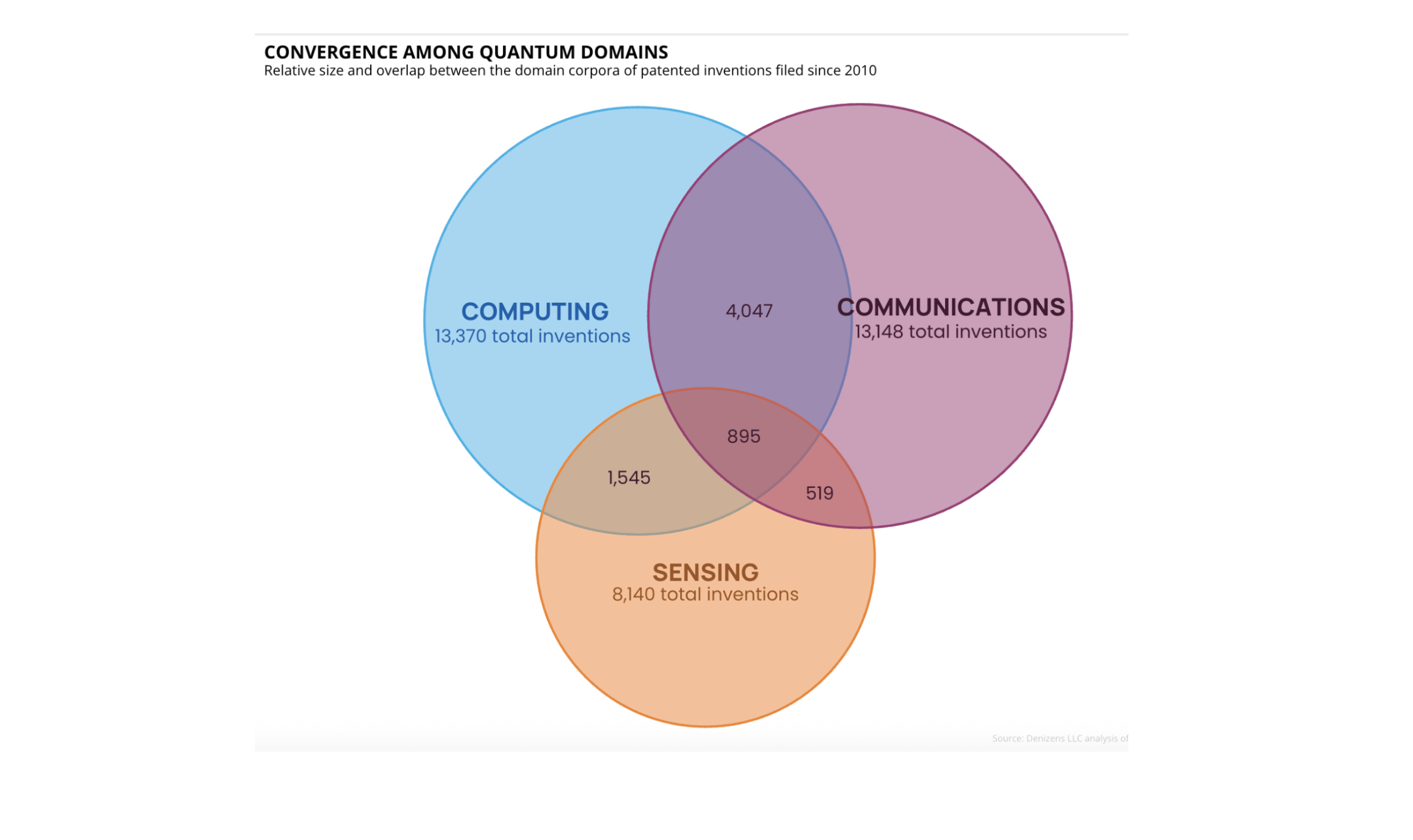
The three main application areas are sensing (ultra-precise measurement), communications (highly secure data transmission), and computing (solving complex problems that are beyond today’s reach). Luckily for the Mountain West, sensing is the most immediately practical of these applications, and where the region has the strongest hand to play.
What Is Quantum Sensing?
Quantum sensing, in a nutshell, is about extraordinarily precise measurements. Quantum sensors can measure time, motion, gravity, and magnetic fields with accuracy far beyond what is currently possible, improving decision making in areas such as environmental monitoring, infrastructure, navigation, and more.
Wildfire prediction is a prime example. Quantum sensors will be better able to detect early atmospheric conditions that make wildfire ignition more likely. They can measure wind patterns and humidity gradients at a level of precision that conventional instruments can't match, giving fire behavior models sharper inputs and forecasters a longer window to act.
Sensors can also detect potential ignition sources. For instance, a quantum magnetometer could detect the subtle magnetic signatures of electrical faults in power lines - one of the leading causes of catastrophic wildfires - before a spark ever reaches dry vegetation.
The biggest barrier facing quantum sensing right now is the transition from laboratory demonstrations to real-world, repeatable, and scalable use. Turning theoretical ideas into tried-and-true applications requires not just scientific breakthroughs, but reliable systems that hold up under the demands of actual users. This is where the U.S. National Science Foundation ASCEND Engine can help.
Implications for ASCEND Technologies
The NSF ASCEND Engine - led by Innosphere - develops technologies in advanced sensing and computation that support environmental decision-making. These technologies will be greatly enhanced by quantum sensing. ASCEND technologies help communities predict, prepare for, and respond to natural hazards such as wildfires, drought, and extreme weather. While quantum sensing isn’t a finished product yet, the underlying capabilities are increasingly relevant: more precise environmental monitoring, better measurement of water systems, and improved geospatial awareness for disaster prediction and response.
The Mountain West – a Significant Innovation Hub
The Mountain West, meaning Colorado, New Mexico, and Wyoming, has steadily built a serious base in quantum technology, with each bringing complimentary strengths to the table. The region has produced roughly 600 quantum inventions since 2010, and on a per-job basis, quantum specialization here runs nearly three times the national average. This reflects decades of investment in research institutions, a wealth of national laboratories, and a growing startup ecosystem.
The Bottom Line
Quantum innovation isn’t a race, but rather a strategic positioning. One where the Mountain West is set up to succeed.
To learn more about the impact of quantum technologies in Colorado, attend our Innovation After Hours event on Thursday, May 21, from 4-6 pm. Register for the Event
The full report will be released on May 18th, 2026. Read it on innosphere.org and be sure to sign up for our newsletter below.