

Colorado Slipped in Milken's Best-Performing Cities: Here's the Plan to Climb Back

"If this event were at any other time in the last 15 to 20 years, Colorado is generally looking great," said Brock Smith, head of research development at the Milken Institute. “For most of that time, Denver hovered around the top 20 in Milken's Best-Performing Cities report, and Fort Collins, Colorado Springs, and Boulder held steady in the top 60 to 70.”
Key takeaways
- Four of Colorado's five largest metros [Denver, Fort Colins-Loveland, Greeley, and Boulder] dropped more than 40 places. Drops were driven mostly by three metrics: one-year growth in jobs, one-year growth in wages, and high-tech GDP.
- One-year metrics are volatile and may reflect a temporary dip, or they may signal the start of a long-term trend.
- Colorado already has the core ingredients necessary for growth (research universities, national labs, workforce programs, capital, and support services). What it lacks is coordination between these elements and across industries.
- The newly formed Colorado Innovation Council (CIC), facilitated by Innosphere, is designed to coordinate across four advanced-industry organizations (Colorado BioScience Association, Colorado Space Coalition, the NSF ASCEND Engine, and Elevate Quantum). Cross-industry coordination will allow the advanced industries to share infrastructure and talent, put on a united front when advocating for policies and seeking resources, sustain focus for the long timelines necessary for many advanced-industry developments.
What the Milken data shows
The Best-Performing Cities Report is the Milken Institute's flagship publication. Published yearly, it ranks 400 metro areas across the United States on how well they create and sustain jobs, wages, and economic growth. The 2026 rankings draw on data from January through December 2024.
This year, four of Colorado's five largest metros fell more than 40 places in the Milken Institute’s Best Performing Cities Report. The Fort Collins-Loveland area fell more than double that, sliding 94 spots from 21 to 115. Even Colorado Springs, which held up best, slipped out of the top 10.
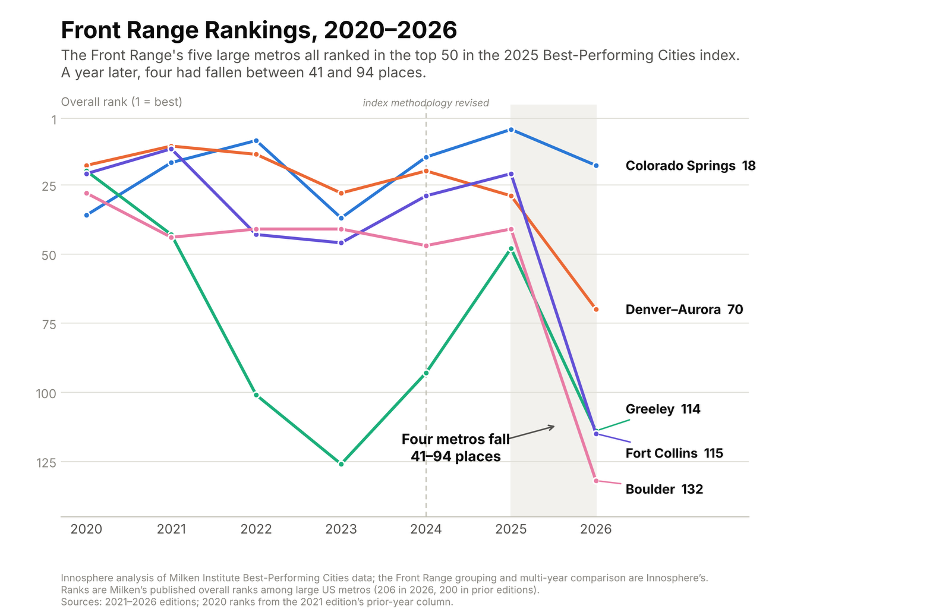
This sudden drop is why Innosphere and the NSF ASCEND Engine recently invited the report’s author, Brock Smith, to walk through the 2026 findings. We then convened a panel of experts, industry leaders, and economic development partners to discuss what the numbers mean and what Colorado can do about them.
"These drops have mainly been driven by the one-year growth categories, such as one-year growth in jobs, one-year growth in wages, and one-year growth in high-tech GDP," Smith said. Those categories matter because they track what people feel day to day. Slower job growth means fewer openings for new graduates and people looking to change careers. Slower wage growth means smaller raises in a state where housing already takes a large share of a paycheck.
One-year measures are volatile, though, and Smith was careful not to overstate what they show. A single year of slower growth can reflect a temporary slowdown as easily as a lasting shift, and he stopped short of naming a definitive cause. In other words, changes in ranking should be considered warnings that invite attention and analysis, but don’t yet qualify as an emergency.
The ingredients are here, but coordination is missing
Despite the new rankings, Colorado does a lot of things right. "Colorado is leaps and bounds ahead of so many other states," said Rachel Halfacre, Director of the Community Infrastructure Center at the Milken Institute. She identified five strengths: a deep talent pool and strong workforce, capital from early-stage investment through late-stage commercialization, wraparound services from startup programs to scale-up accelerators, infrastructure (housing and broadband, plus shared facilities for high-tech industry), and customers ready to buy what Colorado companies make.
Other panelists added the state's research universities, technology coming out of its national labs, and community college programs that train workers for these industries as additional strengths. Colorado has also won two highly competitive federal awards in recent years: a U.S. Economic Development Administration Tech Hub designation for Elevate Quantum, and the NSF ASCEND Engine, which serves Colorado and Wyoming. Add the Colorado BioScience Association and the Colorado Space Coalition, and the state has strong organizations representing many of its advanced industries.
The problem is that those organizations tend to work in silos. Ryan Tharp, a partner at FBT Gibbons, put it plainly:
"What Colorado seems to lack or is harder to find is coordination," Tharp said. "It's helping the capital find the deals; it's helping the policy keep pace with the science. It's helping schools, universities, and community colleges train the workforce relevant to these industries. And it's creating that pipeline between the university labs and the cap tables."
That gap shows up in the concerns panelists raised: a sense that Colorado's competitiveness is slipping, companies leaving the state, rising costs of living, and friction in finding and keeping skilled workers. Colorado's advanced industries are all headed in the same direction, and it makes sense for them to combine their efforts to get where they are going faster and more efficiently.
The Colorado Innovation Council
The Colorado Innovation Council is a voluntary partnership among four advanced-industry organizations: the Colorado BioScience Association, Elevate Quantum, the Colorado Space Coalition, and NSF ASCEND Engine (which is part of Innosphere). Innosphere will facilitate the Council through 2027, when it is planned for the Council to be self-sustaining. What the CIC specifically isn’t, is a new nonprofit competing for the same funding and attention as everyone else.
"We have banded together to create a new form of collaboration without creating a new nonprofit or entity that's looking for time and attention," said Mike Freeman, CEO of Innosphere and the NSF ASCEND Engine. "Instead, it is harnessing the collective strength, budget, and wisdom that we already have into a unified effort to advance Colorado's advanced industries simultaneously."
Advanced industries are where the growth is, "In Colorado, we have a unique opportunity to really advance and win in multiple advanced industries: life sciences, aerospace, space innovation, advanced sensing computation, quantum and photonics," Freeman said.
Tharp sees the same logic. "All of these great organizations: Innosphere, Colorado BioScience Association, Elevate Quantum and the Colorado Space Coalition. They are all really strong in their own verticals, but by expanding and working together and coordinating all of their knowledge and their know-how, they are able to grow and expand the entire ecosystem in a way they wouldn't be able to just individually."
Investors on the panel welcomed the CIC. For them, its establishment signaled an innovation community working together, making it easier to spot investable companies built on regional research and partnerships. They described non-dilutive federal and state grants as a way to de-risk early technologies before private investors step in to carry them to market. The goal is a clearer path from a grant-funded milestone to a go-to-market plan, and more local investors ready to back that next step.
What success looks like
Freeman offered a straightforward scorecard for what success for the CIC would look like. "You can measure that through a whole variety of factors: new innovations, startups, capital, business relocation."
None of these factors will move overnight. Quantum, space, and life sciences run on roadmaps measured in years, sometimes decades, and they need steady attention and steady funding to stay on track. The panel was clear that Colorado doesn't need to be the best state for every technology. It needs to lead in areas where it already excels.
Whether the 2026 rankings are a one-year dip or the beginning of a trend depends a lot on the ability of advanced industry organizations working together to strengthen the ecosystem necessary for their innovations (and consequently Colorado) to flourish.