

Advanced Industries – How Colorado Compares
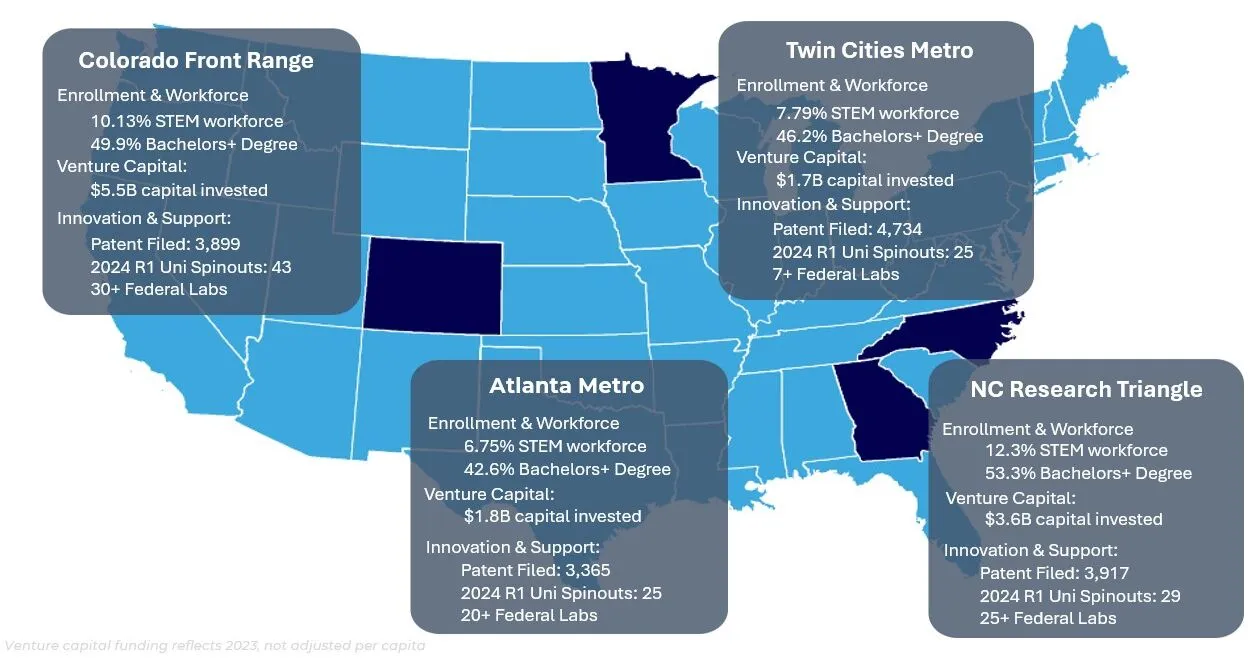
Colorado’s Front Range has long been recognized as one of the nation’s most dynamic emerging innovation hubs anchored by world-class universities, a deep STEM workforce, and the nation’s largest concentration of federal laboratories outside of Washington, D.C. As national attention turns toward regional competitiveness and the geographic spread of advanced industries, Colorado’s performance increasingly mirrors the trends highlighted in the Brookings Institution’s work on innovation districts. Brookings has consistently argued that U.S. innovation remains too concentrated in a small set of coastal metros and recommends scaling regional Innovation Engines that blend research institutions, workforce strength, and startup formation.
As one of Colorado’s leading innovation accelerators, Innosphere, reflects the place-based technological development advocated by Brookings. Through its long-standing presence in Colorado’s startup ecosystem, Innosphere leverages local research institutions, entrepreneurial talent, and regional industry strengths to commercialize scientific discovery, build advanced industry clusters, and generate durable economic advantage in fields where Colorado has clear technological momentum.
What Is an Innovation Engine?
An Innovation Engine is a regional platform that integrates research universities, federal labs, industry partners, entrepreneurial support systems, and public-sector investment to accelerate technology commercialization at scale. Engines are built on three core pillars:
- Research Excellence: A concentration of R1 universities and federal labs generating high-value intellectual property, advanced research, and talent pipelines.
- Commercialization Capacity: Accelerators, incubators, venture funding, corporate partners, and workforce programs capable of turning research into scalable companies.
- Regional Coordination: State and local agencies aligning incentives, infrastructure, and strategic investments around targeted industry clusters.
Colorado checks all three boxes. With five R1 universities along the Front Range, more than 30 federal labs and R&D centers, and a robust accelerator network, Colorado’s ecosystem is effectively structured as a horizontally integrated engine capable of maturing multiple advanced industries.
How Colorado Compares Across Key Dimensions
Our recent Regional Competitiveness Report examined the performance of Colorado’s Front Range on key innovation indicators against the Atlanta, Twin Cities, and NC Research Triangle peer regions. These indicators include:
- Education & University Output
Colorado’s education system is one of the state’s greatest advantages. The Front Range’s five R1 universities produced more STEM talent than competing regions, and in FY2024, CU Boulder ranked #1 nationwide in university spinouts, generating 43 new companies—more than Atlanta (25), the Twin Cities (25), or the North Carolina Research Triangle (29). These spinouts are a key indicator of how effectively Colorado translates research into entrepreneurship.
- Talent & STEM Workforce
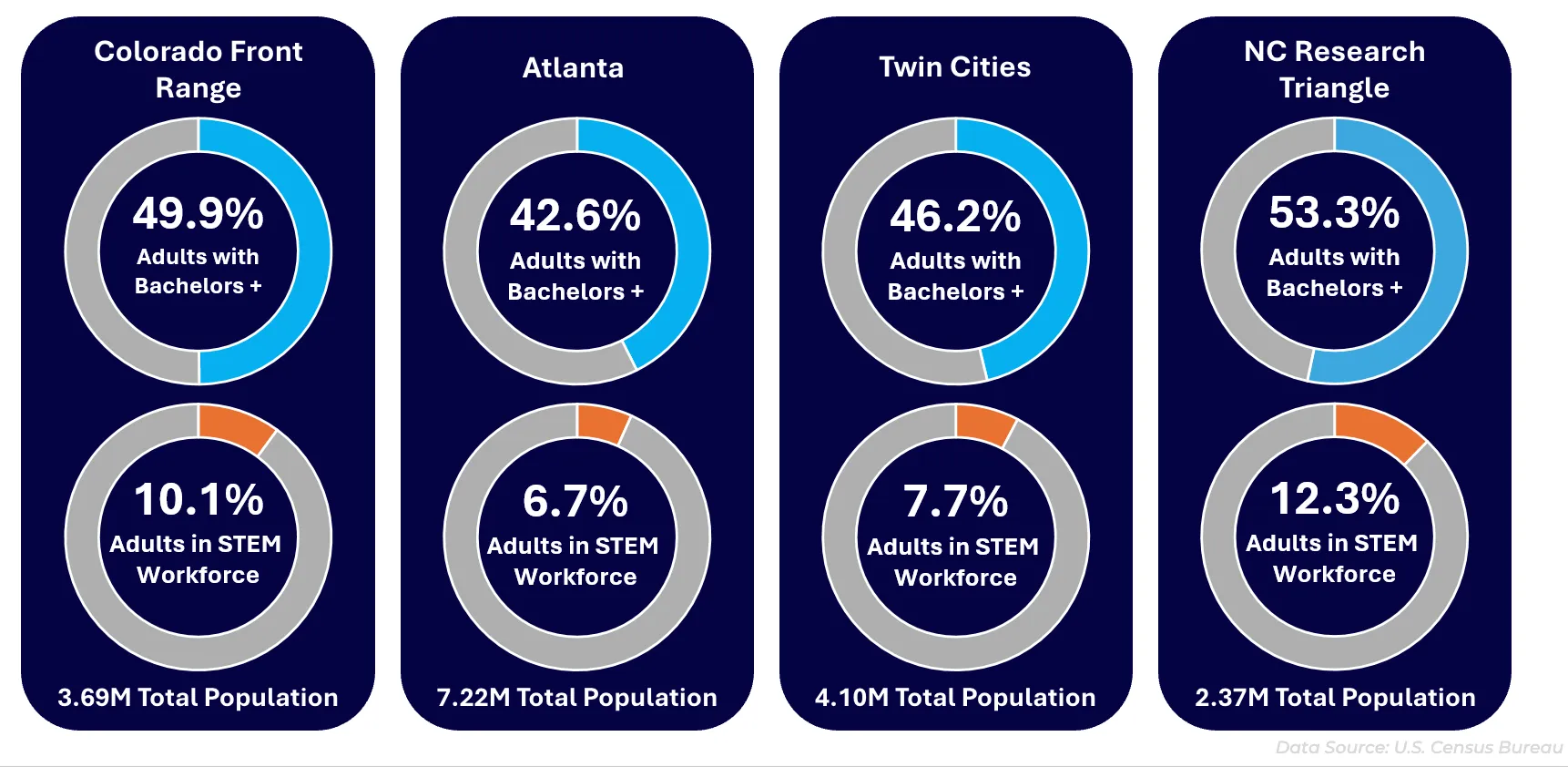
Colorado maintains one of the highest educational attainment rates among large U.S. metros: 49.9% of adults hold a bachelor’s degree or higher, and 10.1% of the regional workforce is in STEM roles, second only to the lower population Research Triangle’s 12.3%. This is a cornerstone regional strength as advanced industries rely on high-skill technical talent, and regions with deeper STEM labor pools tend to sustain more rapid innovation.
- Patent Intensity & Federal Research Infrastructure
Patent intensity, defined by patents per 100,000 residents, is a strong measure of how effectively a region converts research into intellectual property. Colorado produces 45.7 patents per 100k people, outperforming Atlanta and the Research Triangle and nearly matching the Twin Cities’. Importantly, Colorado pairs this with 30+ federal labs focusing on areas including quantum computing, energy technology, and disaster modeling. Together, these institutions give the state an exceptionally high research density, especially in cutting-edge advanced industries.
- Accelerators & Entrepreneurial Infrastructure
Across the four regions, Colorado has one of the most established accelerator networks, blending software-focused programs like Techstars Boulder with deep-tech and life sciences programs such as Innosphere. Atlanta and the Research Triangle, backed by the Georgia Research Alliance and NC Biotechnology Center, respectively, also have robust infrastructures, but Colorado stands out for its combination of early-stage support, lab access, and federal partnerships.
- Venture Capital & Startup Capacity
Colorado leads the comparison group in both VC-backed startups (2,089 between 2020–2024) and total venture investment ($27.1B). Colorado also leads the country in per-capita innovation funding at $1,009 per person, far ahead of North Carolina ($588), Georgia ($485), and Minnesota ($444).
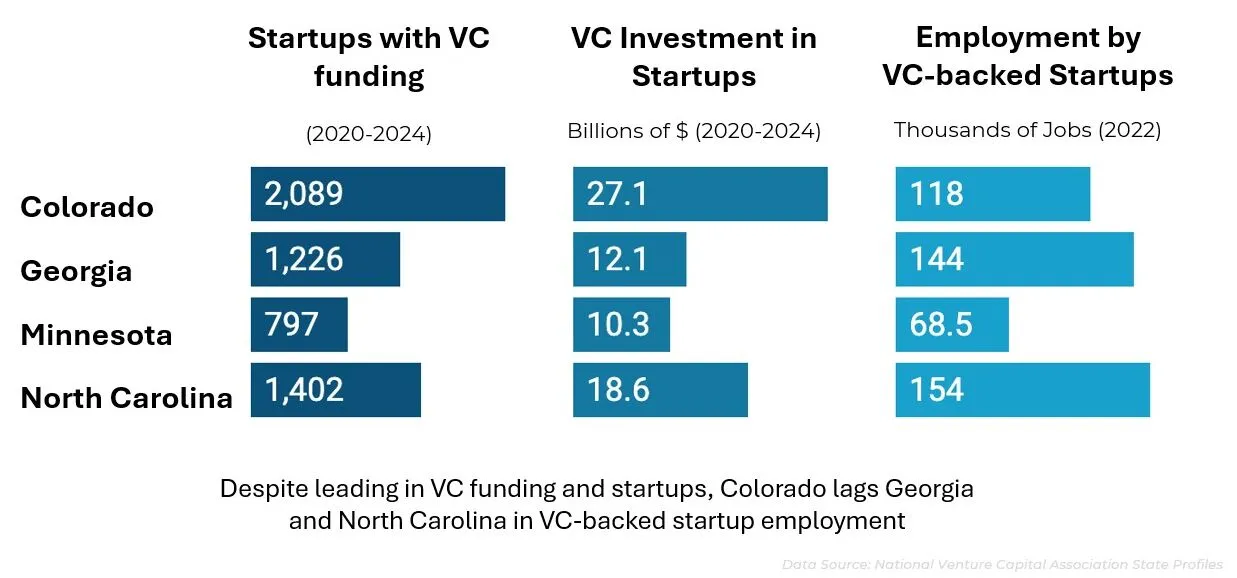
However, Colorado lags in VC-backed employment, trailing both Georgia and North Carolina. This suggests that while Colorado excels at attracting investment and founding companies, scaling those companies into large employers remains a comparative challenge.
- State Support & Policy Landscape
Colorado’s advanced industry funding programs include:
- Advanced Industries Accelerator Program ($21.9M in FY23–24)
- Colorado Quantum Fund ($74M refundable tax credits)
- Colorado Venture Capital Authority ($50K–$1M seed investments)
- Quantum Research Seed Grants
While these programs position Colorado well against Georgia’s Invest Georgia, North Carolina’s NCBiotech, and Minnesota’s Forward Fund, other states have more effectively leveraged funding towards specific advanced industries.
Conclusion: A Region on the Cusp of National Leadership
When compared to peer innovation regions, Colorado outperforms across most advanced-industry metrics. With stronger patent output than Atlanta and the Triangle, more federal labs than any comparison region, deep R1 university output, and the nation’s highest per-capita innovation funding, Colorado is positioned as a rising national leader.
However, to fully realize its potential, the state must expand domestic VC investment, strengthen scale-up pathways, and continue aligning its public-private partnerships. This model, following the coordination prescribed by the Brookings’ Innovation District research, provides Colorado’s innovation economy with a roadmap to lead the development of the emergent technologies that will shape our world.